
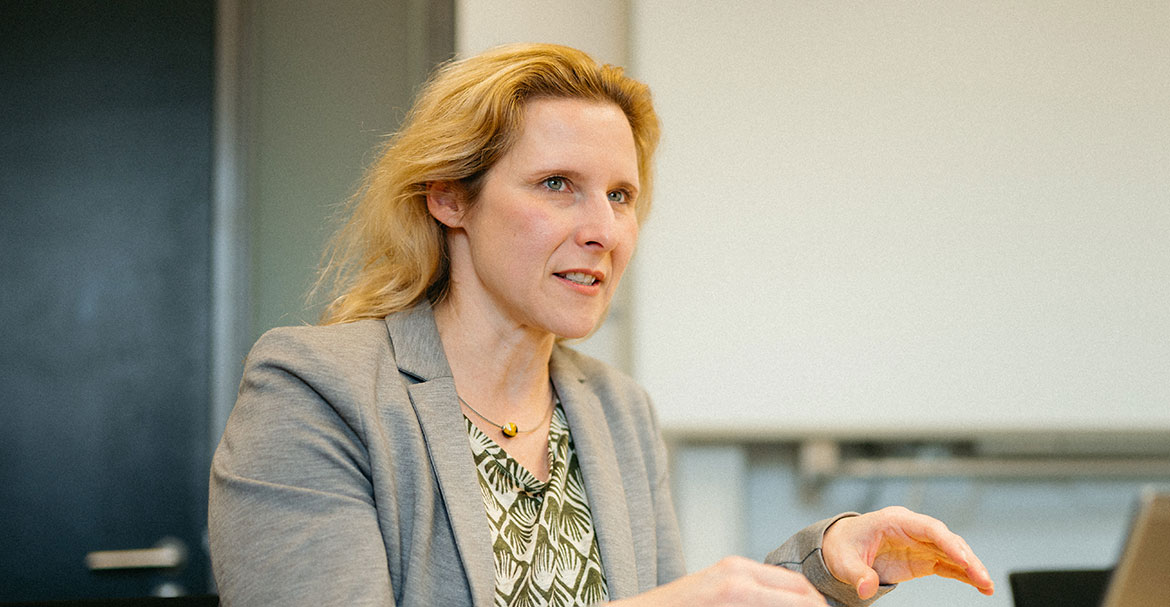
The teacher education program in Potsdam took on the associated challenges and has since developed a highly effective approach to inclusive education. Through research, teaching, and knowledge transfer, it contributes to transforming existing educational and school systems so that they can accommodate the diversity of learners. “However, this can only succeed if all stakeholders collaborate,” says Katrin Böhme, who, as a Professor of Inclusive Education with a focus on Language, is also the department’s spokesperson. On the one hand, she sees this network as comprising all those at the university who conduct research in educational science and incorporate their findings into the training of a “new generation of teachers”; on the other hand, she refers to the school community, which includes not only teachers and students but also parents, supporting organizations, and local authorities.
Within the university, inclusive education is already well established and, with three of seven professorships, is also actively involved in the university’s research focus “Education for the Future.” Study content on inclusive education is implemented at all levels of teacher training. A comprehensive curriculum has been developed for the primary level that encompasses language learning, mathematics education, and social and emotional development, and incorporates diversity resulting from culture and migration. In the near future, cognitive development will also be part of the primary-level curriculum. The secondary-level special education program is also clearly aligned with the goal of working in inclusive schools.
From integration to inclusion
When talking about inclusion, the focus has long since shifted from integrating children and adolescents with “disabilities” into existing lessons to creating a new learning environment in which every individual can develop according to their own talents, unique circumstances, and individual learning needs. “This is based on a fundamental understanding that recognizes human diversity and considers it an enrichment. It is a shift in perspective,” says Michel Knigge, Professor of Inclusive Educational School and Teaching Development. The focus is not on the problem, behavioral issues, or the need for support, but on the school system. “It works for some, but not for others. Above all, it must be adapted to suit the vulnerable, who require special support,” Knigge says.
Professor Antje Ehlert, who specializes in learning support within the field of inclusive education, reports on a project in which concrete changes were achieved in collaboration with elementary schools. A PhD student had implemented a “response to intervention” approach in math in first-grade classes. To this end, teachers at these schools received additional training. The researchers provided learning materials for different needs, which could be used in both whole-class and small-group instruction. Student teachers provided one-on-one help to the children who needed the most support. A second PhD student observed and analyzed the subsequent learning process. The result was an internally differentiated curriculum developed in collaboration with the teachers, in which students with learning difficulties are supported and gifted students are challenged. The findings of this study were then incorporated into the training of student teachers.
“Continuing education and knowledge transfer are not a one-way street,” Prof. Knigge confirms. He has just organized a symposium with the Brandenburg Association for Special Education. Here, practitioners share experiences, creative approaches, and viable strategies – both small and large – toward inclusive education. “A school can develop its own solutions. We don’t know the single correct way. Good solutions come in many forms,” Knigge is convinced.
Inclusion as a means of enabling participation
Linda Juang reminds us not to underestimate the sense of group belonging among children and adolescents. “Some have better access to education due to their background, others less,” says the Professor of Inclusive Education with a focus on Diversity. With her team, she researches, among other things, how ethnic identity and experiences of discrimination affect the well-being and development of adolescents with a migration background. Prof. Juang broadens the concept of inclusion, ultimately seeing it as a means of enabling participation. What matters, she says, is breaking down barriers in interaction with other people and the environment and conveying that diversity is normal and a strength. The researcher illustrates this in the context of multilingualism, which is now a reality in classrooms and “should not only be viewed as a problem but can also be used for the development of society.” Timo Hennig, Professor of Educational Psychology with a focus on Inclusion, also calls for a broad understanding of inclusion. He notes that the current school system is highly categorical. While categories are necessary so that teachers know what they can do, this should not lead to people being classified and evaluated solely based on achievement standards. Deviations are often seen as the child’s problem, rather than a “mismatch” in which the child’s unique characteristics do not align with the learning environment. This is the case, for example, when a girl or boy with attention-deficit/hyperactivity disorder (ADHD) cannot sit still, but the lesson takes place entirely while sitting, the psychologist explains. “Inclusion requires a different way of thinking and acting,” he emphasizes. This is another reason why students must develop the ability to reflect thoroughly on their own educational views and attitudes.
The ability to observe thoroughly
“Many students bring their practical experiences from school into the seminars, which in turn raises new research questions,” Prof. Hennig reports. Part of studying inclusive education also involves conducting research oneself and interpreting scientific findings in order to plan, implement, and evaluate inclusive instruction in an evidence-based manner. “We must empower students to think critically,” emphasizes Professor Oliver Wendt. It is outdated to say: We know, you do! “There is much we do not know, and we involve students in the research,” says the Professor of Inclusive Education, whose research focuses on intellectual development. He and his team are, for example, investigating how people with cognitive and emotional developmental impairments, such as autism, can be supported in their communication.
However, providing targeted support for children and adolescents requires recognizing their needs. This, in turn, also requires diagnostic skills, which are taught in the inclusive education program. According to Prof. Wendt, it is not about applying standardized tests developed for professionals, but rather about the ability to observe thoroughly and, through sensitive conversations with the children and their parents, to determine what kind of help is appropriate or whether they need extracurricular support. Under no circumstances should the diagnostic process lead to the stigmatization of the child.
Prof. Ehlert also relies on the knowledge of experienced teachers who have found their way and share their experiences in professional development sessions. “We can learn from this, draw inspiration from it, and build on it.” The common goal remains to design learning environments in such a way that all children benefit from them. She emphasizes that “the one textbook for all” serves only as a guide, pointing to the possibility of using artificial intelligence to tailor content and assignments so that they can be understood and completed by everyone.
“There is also reasonable skepticism toward AI in the education system. Recognizing and considering both the potential and the challenges requires critical AI literacy. There is still a great need for continuing education for teachers in this regard,” Prof. Böhme says. As part of the “lernen:digital” competence network, she and her team investigated in the “KISS-Pro” project how generative artificial intelligence can be used for language learning. They are also researching how intelligent tutoring systems and social robots can help students stay motivated to learn. Böhme aims to integrate inclusion and technological development and sees the great potential of adaptive AI systems to address the increasing heterogeneity in classrooms.
Changing Job Profile
According to the researcher, a differentiated view of learners has already taken hold in many places. However, the shift toward a teaching approach that focuses not on the teacher but on individual students is often perceived as particularly challenging. “We live in a time when certainties are fading and expectations – including those placed on schools – are rising. And all this with limited resources.” Katrin Böhme is aware of the increasing strain on teachers, whose work is also in the public eye and subject to constant commentary. However, it has been shown that this burden is reduced in schools where teachers cooperate more.
“The transformation that comes with inclusive education necessarily leads to a shift in basic attitudes and a changed job profile,” says Michel Knigge. “Of course, teachers would love to have ready-made solutions that work in every situation. But they don’t exist.” They usually have to be found in the specific context of a classroom situation. This can be frustrating for student teachers at times, according to Knigge. “But we can help by introducing them to successful examples, teaching them to cope with emerging uncertainties, and develop tolerance for ambiguity,” he says, adding: “When student teachers start to work at schools using new ideas and methods, they sometimes encounter tension within the faculty that they have to endure. That requires team spirit and good internal and external mentors. We need to support them in this.”
Department of Inclusive Education at the University of Potsdam: https://www.uni-potsdam.de/de/inklusion/index
This article appeared in the university magazine Portal - Eins 2026 „Inklusion“.